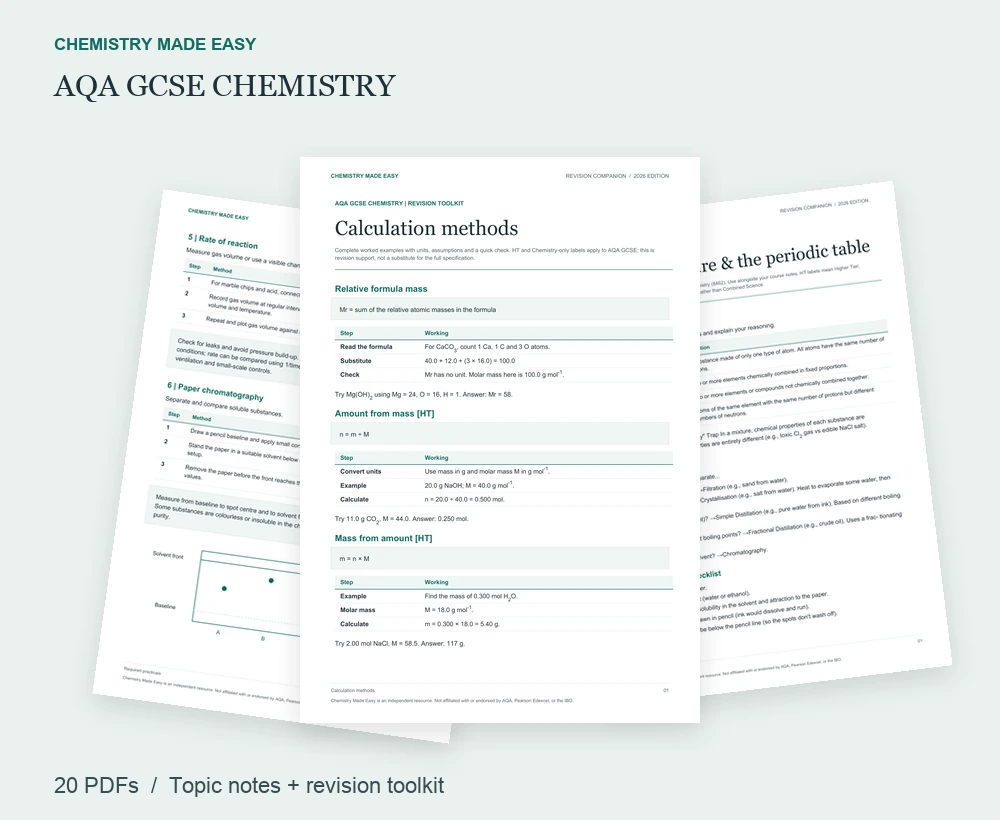
AQA GCSE Revision Kit
20 PDFs: ten topic summaries, 200 recall questions with answers, practicals and revision tools.
Explore the GCSE kit · £1A clear breakdown of our chemistry courses, exam structures, and topic guides across all 5 major specifications.
Welcome to the Chemistry Made Easy Resources Hub. Success in chemistry exams requires a clear understanding of the course specification and assessment formats. Below, we break down the exam patterns across our major specifications (GCSE AQA Chemistry, IGCSE Edexcel Chemistry, AQA A-Level Chemistry, OxfordAQA A-Level Chemistry, and IB Chemistry), helping you focus your study on what matters most.
Prefer studying on paper? These previews show actual pages from our revised PDFs, with clear headings, readable tables and worked examples.
20 PDFs: ten topic summaries, 200 recall questions with answers, practicals and revision tools.
Explore the GCSE kit · £1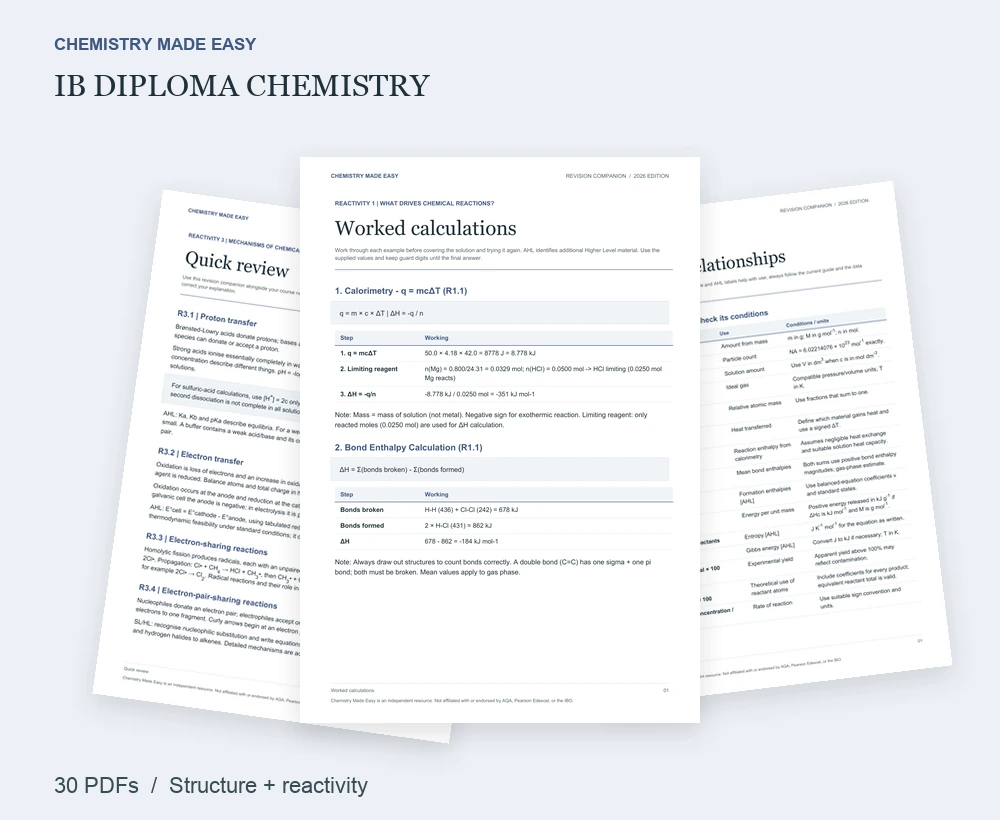
30 PDFs across the six Structure and Reactivity units, with selected SL/HL and additional HL content.
Explore the IB kit · £1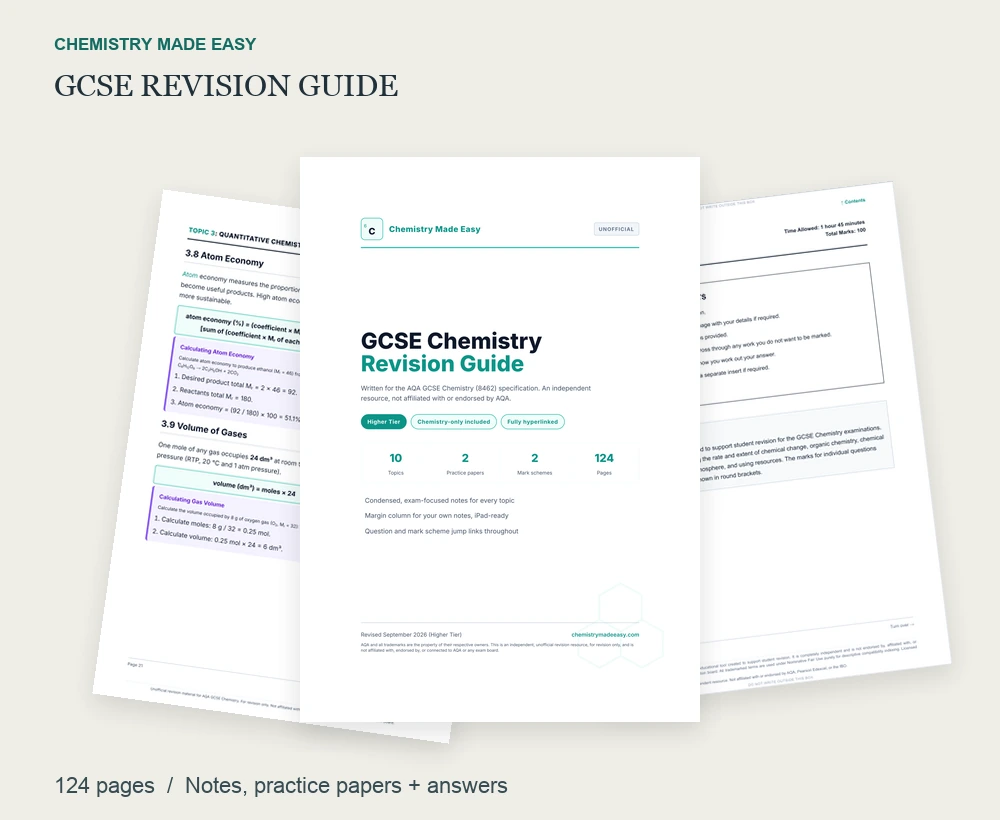
124 pages of topic notes, two practice papers and mark schemes, with linked contents.
Explore the guide · £4.99The AQA GCSE Chemistry (8462) assessment consists of two written papers. Both papers test distinct topics and require a mix of mathematical skills, practical knowledge, and theoretical understanding. Depending on your entry tier, the questions range in difficulty, but the overall structure remains consistent. Paper 1 covers the foundational topics such as atomic theory, periodic trends, bonding, and quantitative calculations, which form the base for all subsequent chemistry concepts. Paper 2 shifts the focus towards applied chemistry, including chemical rates, organic structures, chemical analysis, environmental science, and sustainable resource management. Both papers are equally weighted, meaning students must maintain a consistent performance across the entire syllabus.
Each paper has a specific list of topics, duration, and weighting. Check the breakdown below to understand how the topics are divided.
| Assessment | Topics Covered | Separate Science Format | Combined Science Format |
|---|---|---|---|
| Paper 1 | Topics 1 to 5: Atomic Structure; Bonding & Properties; Quantitative Chemistry; Chemical Changes; Energy Changes. | 1 hour 45 minutes 100 marks (50% of GCSE) |
1 hour 15 minutes 70 marks (16.7% of GCSE) |
| Paper 2 | Topics 6 to 10: Rate & Extent of Change; Organic Chemistry; Chemical Analysis; Atmosphere; Using Resources. | 1 hour 45 minutes 100 marks (50% of GCSE) |
1 hour 15 minutes 70 marks (16.7% of GCSE) |
Both exams include multiple choice, structured, closed short answer, and open response questions. You will need to apply your understanding of required practical activities, which are assessed across both papers.
Select a topic below to access detailed study notes, practice flashcards, and exam-style questions tailored to the AQA specification:
The Pearson Edexcel International GCSE in Chemistry (4CH1) consists of two externally assessed written papers. Unlike AQA, where topics are split between papers, Edexcel assesses all syllabus sections (Principles of Chemistry, Inorganic Chemistry, Physical Chemistry, and Organic Chemistry) in both papers. The difference is the depth: Paper 1C covers the core, non-bold content, while Paper 2C assesses the entire specification including the more advanced, bold content.
Each paper has a specific duration, mark count, and weighting. Review the assessment structure below:
| Assessment | Content Covered | Duration | Weighting & Marks |
|---|---|---|---|
| Paper 1C | Core topics from all four sections (Principles, Inorganic, Physical, and Organic Chemistry). Bolded sub-topics are not assessed. | 2 hours | 110 marks (61.1% of IGCSE) |
| Paper 2C | All topics from all four sections, including both core and extended (bolded) content. | 1 hour 15 minutes | 70 marks (38.9% of IGCSE) |
Both papers feature structured, short-answer, and open-ended questions. A copy of the Periodic Table is provided, and practical skills are integrated and assessed throughout both exams.
Select a section below to access detailed study notes for each part of the Edexcel specification:
The AQA A-Level Chemistry (7405) qualification is a two-year linear course, meaning all three written examinations are sat at the end of Year 13. The curriculum covers theoretical, mathematical, and laboratory chemistry structured across three core disciplines: Physical Chemistry (Section 3.1), Inorganic Chemistry (Section 3.2), and Organic Chemistry (Section 3.3). Practical expertise is developed through 12 mandatory Required Practicals (RP1 to RP12) assessed by teachers for the Practical Endorsement (CPAC) and examined directly across all three written papers, contributing at least 15% of the total exam marks. Mathematical competencies represent at least 20% of total marks at Level 2 or above.
Assessment consists of three externally examined papers. Papers 1 and 2 target distinct branches alongside foundational physical chemistry, while Paper 3 provides an integrative synoptic assessment:
| Assessment | Topics Covered | Duration | Weighting & Marks | Question Format |
|---|---|---|---|---|
| Paper 1 (Code: 7405/1) |
Relevant Physical Chemistry topics (3.1.1 to 3.1.4, 3.1.6 to 3.1.8, 3.1.10 to 3.1.12), Inorganic Chemistry (3.2.1 to 3.2.6), plus relevant practical skills. | 2 hours | 105 marks (35% of A-Level) | 105 marks of short and long answer questions. |
| Paper 2 (Code: 7405/2) |
Relevant Physical Chemistry topics (3.1.2 to 3.1.6, 3.1.9), Organic Chemistry (3.3.1 to 3.3.16), plus relevant practical skills. | 2 hours | 105 marks (35% of A-Level) | 105 marks of short and long answer questions. |
| Paper 3 (Code: 7405/3) |
Any content across Physical, Inorganic, and Organic Chemistry, plus any practical skills from across the specification. | 2 hours | 90 marks (30% of A-Level) | 40 marks practical techniques and data analysis; 20 marks testing synoptically across specification; 30 marks multiple choice questions (MCQs). |
Students also complete the Practical Endorsement for Chemistry, a non-exam assessment reported separately on certificates as a Pass or Fail. Competence is demonstrated across the 12 Required Practicals covering volumetric analysis, calorimetry, kinetics, organic synthesis, chromatography, and electrochemical cells.
Select a topic below to explore comprehensive revision notes, worked calculation examples, and practice questions:
Study periodic patterns, redox trends, transition metal complexes, and precipitation reactions:
Master reaction mechanisms, functional groups, synthesis pathways, and spectroscopy:
Access practical guides for all 12 Required Practicals and revision planning tools:
The OxfordAQA International AS and A-Level Chemistry (specification 9620) is structured on a flexible modular model consisting of five distinct units (CH01 to CH05). Unlike linear syllabuses where all exams occur at the conclusion of Year 13, the modular format allows students to sit examinations across two dedicated testing windows each academic year: the January Series (Units 1, 2, 3, and 4) and the May/June Series (all units, including Unit 5). Candidates benefit from unlimited resit opportunities for each unit, with the highest raw mark and UMS score automatically banked toward certification. Students can cash in Units 1 and 2 for an International AS Chemistry award (9621) or combine all five units for the full International A-Level Chemistry award (9622). Achieving an A* requires an overall Grade A (at least 400 of 500 total UMS) combined with an aggregate score of at least 90% across the three A2 units (at least 270 of 300 UMS across Units 3, 4, and 5).
Review the examination duration, raw marks, Uniform Mark Scale (UMS) weighting, and content distribution for all five modular units:
| Unit Code & Title | Assessment Scope | Duration | Marks & UMS | Weighting |
|---|---|---|---|---|
| Unit 1 (CH01) Inorganic 1 & Physical 1 |
Section 3.1 & 3.2: Stoichiometry, Atomic Structure, Amount of Substance, Bonding, Periodicity, Group 2, Group 7. | 1 hour 30 minutes | 70 marks 100 UMS |
50% AS 20% A-Level |
| Unit 2 (CH02) Organic 1 & Physical 1 |
Section 3.1 & 3.3: Energetics, Kinetics, Equilibria, Alkanes, Halogenoalkanes, Alkenes, Alcohols, Organic Analysis. | 1 hour 30 minutes | 70 marks 100 UMS |
50% AS 20% A-Level |
| Unit 3 (CH03) Inorganic 2 & Physical 2 |
Section 3.4 & 3.5: Thermodynamics, Rate Equations, Gas Equilibria Kp, Electrode Potentials, Acids & Bases, Period 3 Oxides, Transition Metals, Aqueous Ions. | 1 hour 30 minutes | 80 marks 105 UMS |
21% A-Level (A2) |
| Unit 4 (CH04) Organic 2 & Physical 2 |
Section 3.4 & 3.6: Optical Isomerism, Aldehydes & Ketones, Carboxylic Acids, Aromatic Chemistry, Amines, Polymers, Amino Acids & DNA, NMR Spectroscopy. | 1 hour 30 minutes | 80 marks 105 UMS |
21% A-Level (A2) |
| Unit 5 (CH05) Practical & Synoptic Capstone |
Section 3.7: Written examination of practical skills, experimental design, uncertainty mathematics, Quickfit setups, synoptic links, and Required Practicals RP1 to RP10. | 1 hour 25 minutes | 60 marks 90 UMS |
18% A-Level (A2) |
Units 1 through 4 feature a two-part paper format: Section A consists of multiple choice questions (20 marks) assessing fundamental concepts and rapid calculations, while Section B comprises structured written questions (50 to 60 marks) including multi-step mechanisms, calculation sequences, and free-response explanations. Unit 5 assesses laboratory methodology, experimental error analysis, and synoptic synthesis across the entire two-year specification without requiring a coursework laboratory portfolio.
Select a modular unit or laboratory hub below to access comprehensive revision notes, flashcard decks, and full mock examination papers:
The International Baccalaureate (IB) Chemistry course (for first assessment in 2025) is built around two overarching conceptual themes: Structure and Reactivity. This conceptual design helps students connect various areas of chemistry instead of learning topics in isolation. Under this model, students explore the structural properties of matter alongside the chemical reactivity that drives transformations. The syllabus is designed to encourage critical thinking, experimental design, and the application of chemical principles to real-world scenarios. Standard Level (SL) students acquire a broad, comprehensive overview of these concepts, while Higher Level (HL) students delve much deeper, studying advanced topics such as transition metals, chemical kinetics mechanisms, and complex organic pathways. This distinction is reflected in the length and complexity of the examinations.
IB Chemistry students are evaluated through two external examination papers and one internal scientific investigation. Higher Level (HL) students face a broader syllabus and longer examinations compared to Standard Level (SL) students.
| Assessment Component | Standard Level (SL) Details | Higher Level (HL) Details |
|---|---|---|
| Paper 1 (Paper 1A & 1B) |
1.5 hours duration 36% of final grade (55 marks) |
2.0 hours duration 36% of final grade (75 marks) |
| Paper 2 (Short & Long Answer) |
1.5 hours duration 44% of final grade (50 marks) |
2.5 hours duration 44% of final grade (90 marks) |
| Internal Assessment (Scientific Investigation) |
20% of final grade Individual project (24 marks) |
20% of final grade Individual project (24 marks) |
Paper 1A consists of multiple-choice questions, while Paper 1B focuses on data-based questions relating to experimental work and skills. Paper 2 involves short-answer and extended-response questions assessing knowledge and understanding across all themes.
Explore our topic guides structured around the Structure and Reactivity themes:
Studying chemistry requires a balance of active recall, mathematical practice, and conceptual visualization. To maximize your revision: